Meat is often the most expensive part of a weekly shop, so a Hy-Vee meat sale can change the whole budget for the week. This guide explains how Hy-Vee meat sales work, what a Mega Meat Sale means when one appears, and how to judge whether a per-pound price is genuinely good value. It also lists the meat items verified in Hy-Vee’s current weekly ad, so you can see at a glance what is on offer now and which advice will still help when the next sale arrives.
As checked on 30 October 2026, the meat offers below are from Hy-Vee’s official weekly ad. The flyer itself dates them 26 October to 1 November 2026, while Hy-Vee’s official weekly ads list shows the same weekly ad as valid to 2 November 2026, so treat 2 November availability as something to confirm with your store rather than assume. No separate Mega Meat Sale flyer was listed on the official ads list on 30 October 2026, so this page does not present a separate mega event as live. Prices, promotions and availability may vary by store, as Hy-Vee itself states.
This week’s verified meat items
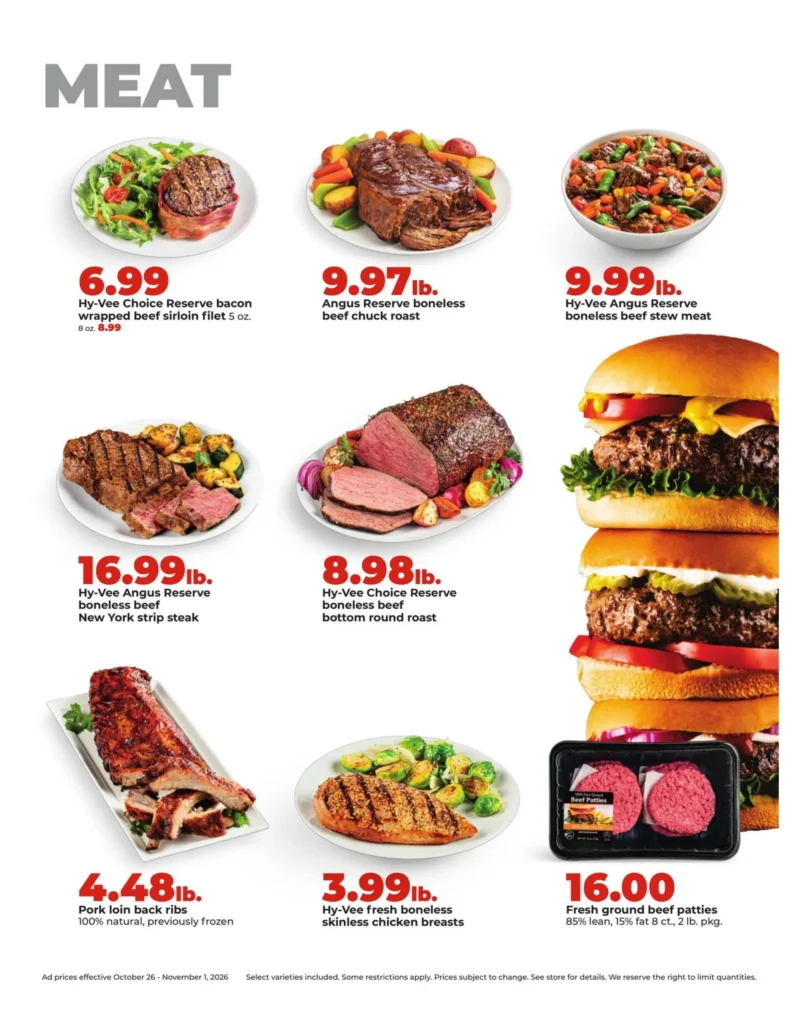
The beef list is the clearest place to see the range. At the lower end, the Choice Reserve bacon wrapped beef sirloin filet is shown at $6.99, while the Angus Reserve boneless beef chuck roast is $9.97 per lb and the Choice Reserve boneless beef bottom round roast is $8.98 per lb. Those are roasting and slow-cooking cuts first, and they reward a longer cook rather than a quick sear.
At the higher end, Angus Reserve boneless beef stew meat is $9.99 per lb and Angus Reserve boneless beef New York strip steak is $16.99 per lb. The gap between a stew cut and a strip steak is the point: the same ad can contain both a budget slow-cook option and a premium steak, and the per-pound price alone does not tell you which is better value for a particular meal.
Beef
- Hy-Vee Choice Reserve bacon wrapped beef sirloin filet: $6.99.
- Angus Reserve boneless beef chuck roast: $9.97 per lb.
- Hy-Vee Choice Reserve boneless beef bottom round roast: $8.98 per lb.
- Hy-Vee Angus Reserve boneless beef stew meat: $9.99 per lb.
- Hy-Vee Angus Reserve boneless beef New York strip steak: $16.99 per lb.
- Fresh ground beef, 80% lean, 20% fat, 16 oz roll, or Butterball ground turkey, 85% lean, 15% fat, 16 oz roll: $4.88.
Pork
- Pork loin back ribs: $4.48 per lb.
- Hy-Vee Midwest Pork bone-in assorted pork chops: $3.88 per lb.
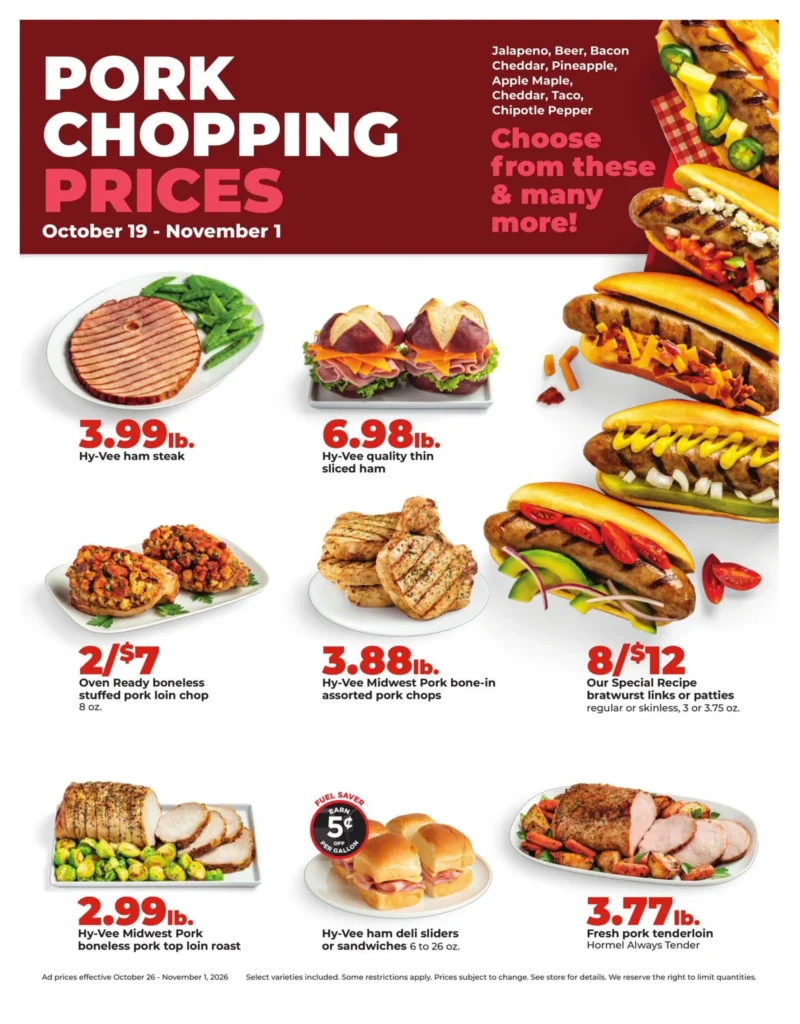
- Hy-Vee Midwest Pork boneless pork top loin roast: $2.99 per lb.
- Fresh pork tenderloin: $3.77 per lb.
- Smithfield marinated pork loin or tenderloin: $5.99.
- Hormel Black Label bacon: $8.99.
- Bob Evans ground sausage, 16 oz roll, sausage links, 14 count, or patties, 8 count: $3.99.
- Oven Ready boneless stuffed pork loin chop: 2 for $7.00.
Chicken, sausage and prepared meat
- Hy-Vee fresh boneless skinless chicken breasts: $2.99 per lb.
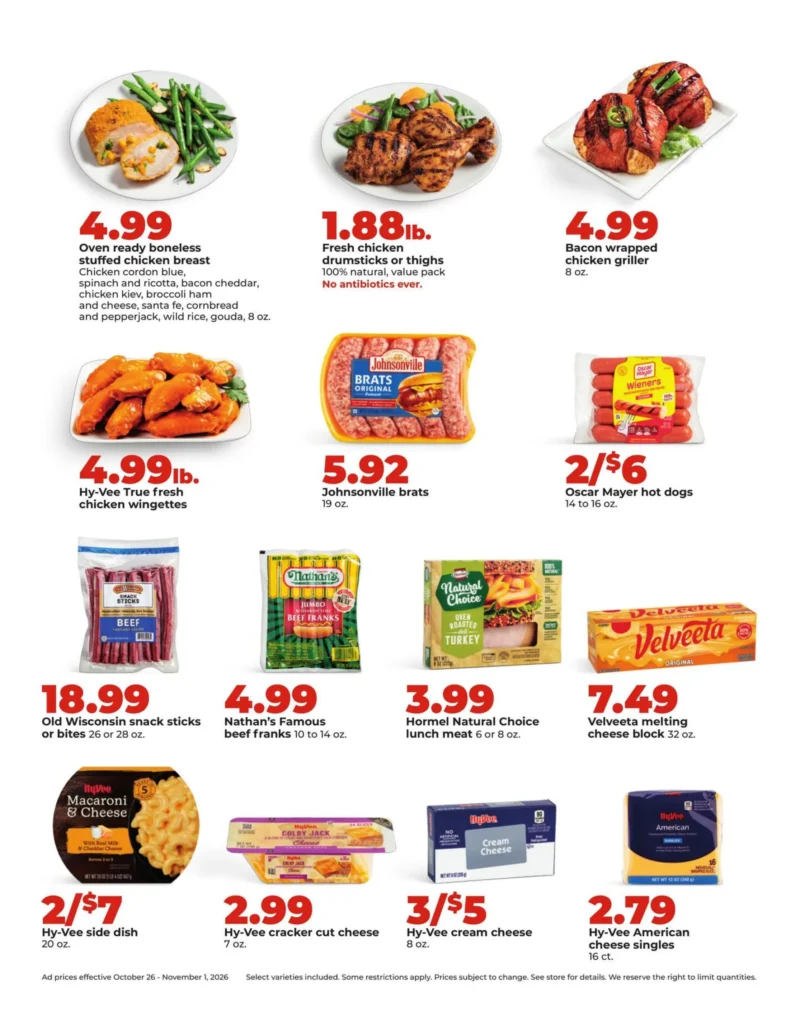
- Fresh chicken drumsticks or thighs: $1.88 per lb.
- Hy-Vee True fresh boneless skinless chicken thighs: $4.49 per lb.
- Hy-Vee True fresh chicken wingettes: $4.99 per lb.
- Johnsonville brats: $5.92.
- Oscar Mayer hot dogs: 2 for $6.00.
- Our Special Recipe bratwurst links or patties: 8 for $12.00.
- Hormel Natural Choice lunch meat: $3.99.
- Hy-Vee ham steak: $3.99 per lb.
Pork is where the current ad is most useful for everyday cooking. A boneless pork top loin roast at $2.99 per lb is the cheapest roast in the meat list, while pork loin back ribs at $4.48 per lb and a fresh pork tenderloin at $3.77 per lb suit smaller households. Marinated pork at $5.99 and the stuffed pork loin chop at 2 for $7.00 cost more because preparation work is already done, so weigh convenience against price.
Chicken gives the clearest budget contrast in the ad. Drumsticks or thighs at $1.88 per lb are far below boneless skinless chicken breasts at $2.99 per lb, and that gap is normal: bone-in, skin-on cuts cost less per pound and stay moist more easily, while boneless skinless breasts are convenient and lean but dry out faster if overcooked. Wingettes at $4.99 per lb and thighs at $4.49 per lb sit in between, and the sausage, brat and hot dog lines are convenience buys rather than stock-up staples unless you have a clear plan and freezer space.
How Hy-Vee meat sales work
A Hy-Vee meat sale is usually not a separate event with its own flyer. Most often, meat prices appear as part of the weekly ad, alongside produce, grocery and frozen items. A themed event such as a Mega Meat Sale is different only in scale and presentation: it groups a larger number of meat items together and names the event, rather than changing how individual prices are shown.
Within that weekly list, several price formats appear. Some items are priced per pound, so the final cost depends on the weight of the pack you pick up. Others are priced per pack, per roll or per item, and multi-buy lines such as 2 for $7.00 or 8 for $12.00 only give the stated value when you buy the full quantity. A third format is a buy-one-get-one offer, where the second item is free; those are worth checking for limits, because the free item may need to be the same variety or size.
Digital coupons and Fuel Saver offers can sit on top of a weekly-ad price, but they are separate layers. A coupon may reduce the till price further, and a Fuel Saver item may earn cents off per gallon, but neither changes the shelf price shown in the ad. Before you shop, check whether an item needs a coupon to be clipped and whether a PERKS price differs from the non-member price, and note that ads often cover selected varieties only.
What a Mega Meat Sale is, and what it is not
When shoppers search for a Mega Meat Sale, they usually mean a larger, themed meat promotion with a wider meat list than a normal week. In general terms, that kind of event tends to feature more cuts across beef, pork and chicken at once, sometimes with bulk packs and multi-buy lines, and it is marketed as a stock-up opportunity rather than a single-item reduction. This page uses that general description only: it does not claim a specific Mega Meat Sale is running now, because no separate Mega Meat Sale flyer was listed on Hy-Vee’s official ads list on 30 October 2026.
The practical difference is therefore simple. If a mega-style event is live, its flyer will name it and date it, and the meat list will be much longer than the meat section of an ordinary weekly ad. If no such flyer is listed, the weekly ad’s meat section is the current offer, and the guidance on this page still applies. Do not assume that a weekly ad’s meat prices are a mega event, and do not carry prices from an older mega event into a new week, because meat prices change with each ad cycle and with store availability.
How to judge a good per-pound price
Start by converting every price to the same basis. For a per-pound price, that basis is already given. For a pack price, divide the pack price by the pack weight if the weight is shown, or compare pack to pack only when the weights match. A $6.99 pack is not automatically cheaper than a $9.97 per lb roast if the pack is small, and a multi-buy total is not a per-item price until you divide it by the number of items you must buy.
Next, allow for bone, skin and cooking loss. Bone-in cuts and skin-on chicken cost less per pound at the till but lose weight before they reach the plate, so a boneless price that looks higher may work out similar per edible pound.
Finally, compare like with like across weeks rather than across cuts. A chuck roast at $9.97 per lb is not directly comparable with a strip steak at $16.99 per lb, because they are different cuts for different cooking methods. Note the per-pound price for the cuts you buy most often, and treat a sale as strong only when it beats your usual price for that same cut.
- Check the unit: per lb, per pack, per roll or multi-buy total.
- Check the quantity needed to get the stated price.
- Check whether selected varieties only are included.
- Allow for bone, skin and cooking loss before comparing cuts.
- Compare with your usual price for the same cut, not with a different cut.
Buying in bulk and freezing guidance
Bulk buying only saves money when the meat is used before it spoils. Fresh sale meat should be cooked or frozen promptly, and the clock starts at purchase, not at the end of the sale. If you cannot cook it in time, freezing on the day you buy it is better than leaving it in the fridge while you decide.
For freezing, portion before you freeze. Divide a large pack into meal-sized portions, press out excess air, label each pack with the cut and the date, and freeze flat where possible so portions thaw evenly. Ground beef and stew meat freeze well in flat packs, while steaks and chops are easier to manage when frozen individually or in pairs. Thaw in the fridge, not at room temperature, and use thawed meat promptly; do not refreeze meat that has already been thawed unless it has been cooked first.
A simple bulk test helps avoid waste. Buy extra only if you have a named meal for it, a labelled freezer space for it, and a realistic date when you will cook it. A second pack of drumsticks at $1.88 per lb is a good buy for a household that eats chicken weekly, but a poor buy if it sits unlabelled in the freezer and is then thrown away.
- Portion into meal sizes before freezing.
- Label each pack with the cut and the date.
- Freeze flat where possible for even thawing.
- Thaw in the fridge and use promptly.
- Do not refreeze thawed meat unless it has been cooked.
Frequently asked questions
Is there a Hy-Vee Mega Meat Sale on now?
No separate Mega Meat Sale flyer was listed on Hy-Vee’s official weekly ads list on 30 October 2026. The meat offers verified for this page come from the weekly ad dated 26 October to 1 November 2026 in the flyer itself. If a mega-style event appears later, it should be listed by name and date on that official list, and this page’s general guidance on judging per-pound prices and freezing will still apply.
Why do some meat prices show per lb and others show a pack price?
Because Hy-Vee prices meat in the way it is sold. Cuts weighed at the counter or in variable-weight packs are priced per pound, so the total depends on the pack weight. Fixed-weight rolls, packs and multi-buy lines are priced per pack or for the stated quantity. Always check which format applies before comparing two items.
Is the cheapest per-pound meat always the best value?
Not necessarily. Bone-in and skin-on cuts are cheaper per pound but lose weight to bone, skin and cooking, while boneless cuts cost more per pound but give more edible meat per pack. Compare the cost per serving for the meal you plan to cook, and compare the same cut across weeks for a fair test.
How long can I keep sale meat in the fridge before freezing it?
Use fresh meat promptly and freeze it on the day of purchase if you do not plan to cook it soon. Keep it refrigerated, follow any use-by date on the pack, and do not rely on a sale date as a storage guide. When in doubt, freeze early rather than risk waste.
What should I do if a sale cut is sold out?
Ask in store whether more stock is expected during the sale period, and look for a similar cut at a similar per-pound price rather than buying a premium cut you did not plan for. A chuck roast can often replace stew meat in a slow cook, and thighs can often replace breasts in a braise, but the cooking time and method may need to change.
A note on sources and accuracy
The current meat items and prices on this page were verified on 30 October 2026 from Hy-Vee’s official weekly ad viewer and Hy-Vee’s official weekly ads list. The flyer dates the weekly ad 26 October to 1 November 2026, while the ads list shows it as valid to 2 November 2026. Hy-Vee states that prices, promotions and availability may vary by store, so confirm the price and availability at your store before shopping. All other guidance on this page is general shopping advice, not a price claim, and it will remain useful after the current ad ends.