Seafood is one of the sections where a weekly ad can genuinely change what lands on the table. A salmon fillet at one price one week and a different price the next is not a trick of the ad; it reflects the way fresh fish, frozen fish and prepared seafood are priced, stocked and promoted. This guide explains how Hy-Vee seafood sales work, lists the seafood items verified in Hy-Vee’s current weekly ad, and gives practical guidance on freshness, storage and choosing between fresh and frozen.
As checked on 30 October 2026, the seafood offers below are from Hy-Vee’s official weekly ad. The flyer itself dates them 26 October to 1 November 2026, while Hy-Vee’s official weekly ads list shows the same weekly ad as valid to 2 November 2026, so treat 2 November availability as something to confirm with your store rather than assume. Prices, promotions and availability may vary by store, as Hy-Vee itself states.
This week’s verified seafood items
The current ad is unusually generous for seafood, with fresh fillets, shrimp in several forms, crab-style products and a small prepared and tinned range. That breadth matters, because it means a shopper who wants a quick weeknight meal and a shopper planning a weekend seafood dinner can both find something in the same flyer. The lists below follow the ad’s own groupings, with prices exactly as shown.
Fish fillets
Salmon leads the fresh fish list, and the contrast between the two salmon prices is worth noting. The Fish Market Pacific salmon fillet is shown at $6.99, while the Fresh Atlantic Verlasso salmon fillet is $12.98 per lb. The difference is a reminder to check the unit: a price without a per-pound basis cannot be compared directly with one that is priced by weight.
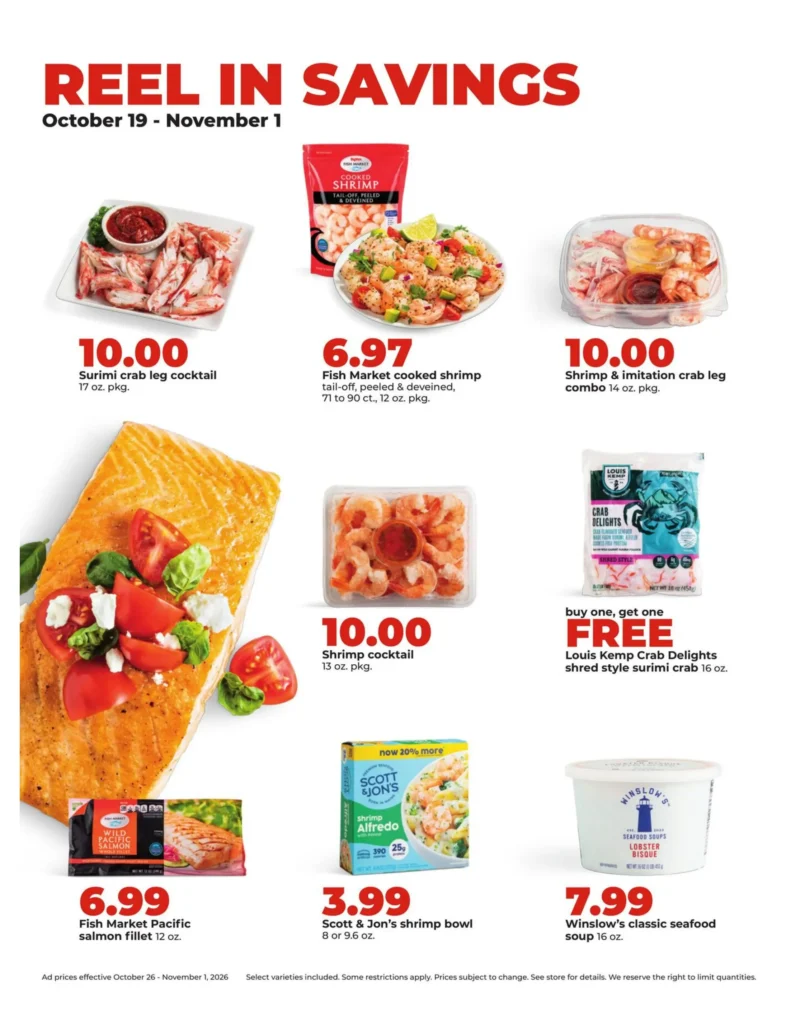
- Fish Market Pacific salmon fillet: $6.99.
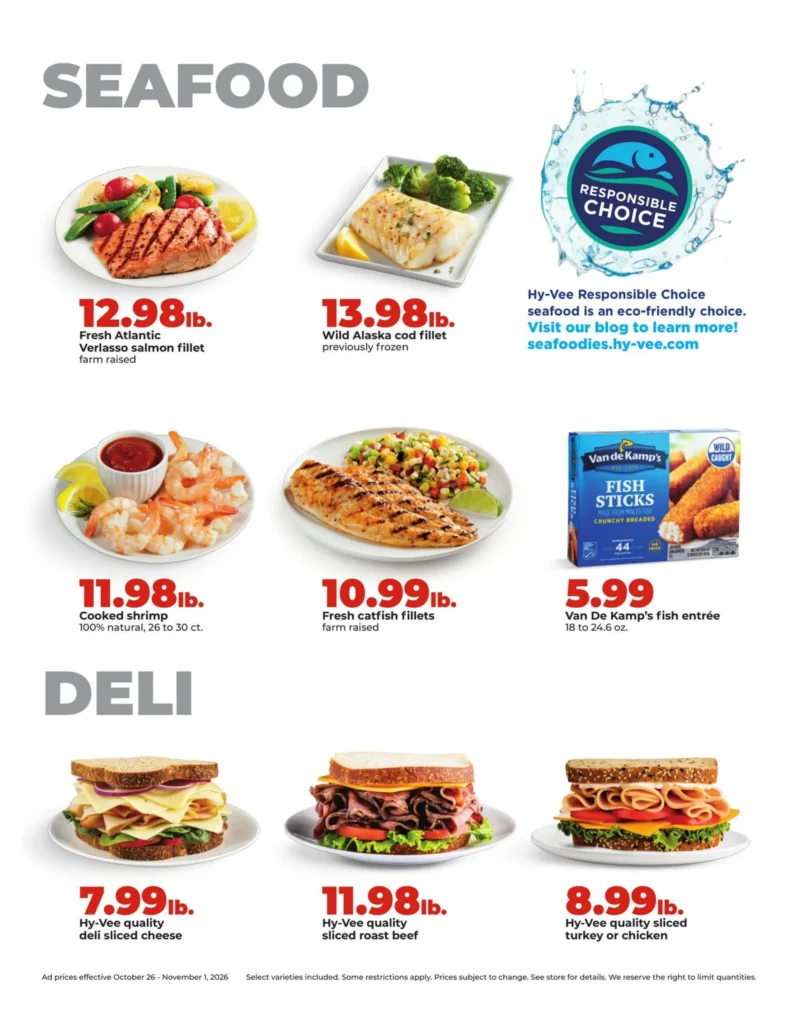
- Fresh Atlantic Verlasso salmon fillet: $12.98 per lb.
- Wild Alaska cod fillet: $13.98 per lb.
- Fresh catfish fillets: $10.99 per lb.
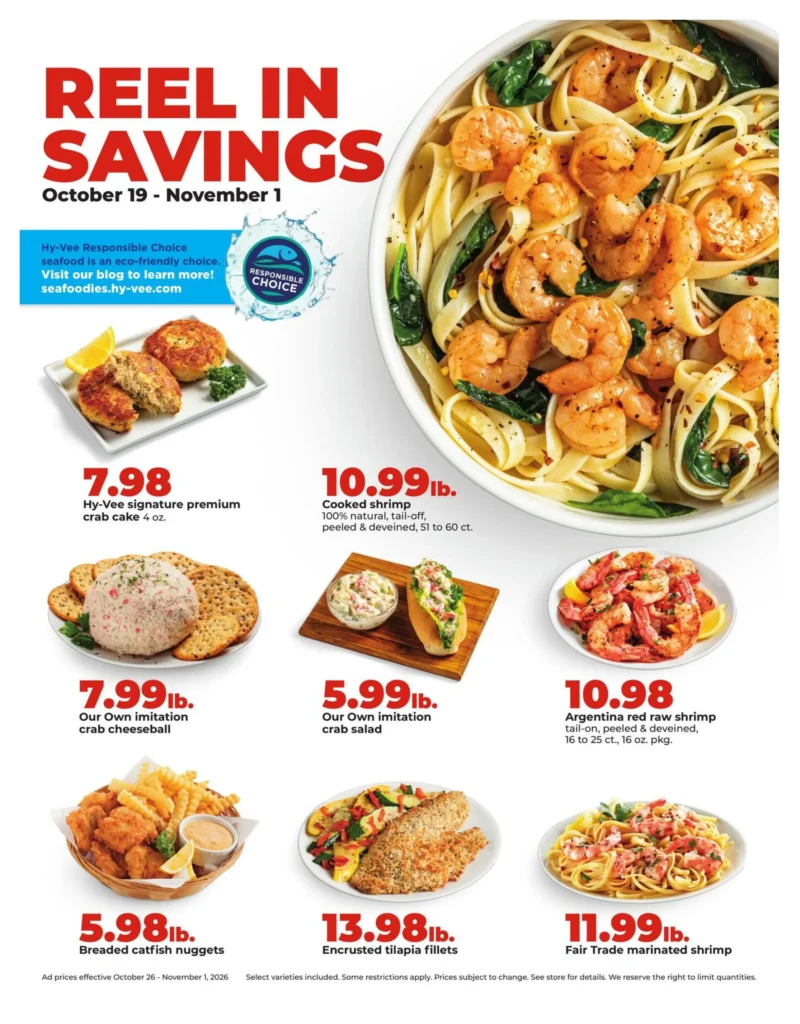
- Breaded catfish nuggets: $5.98 per lb.
- Encrusted tilapia fillets: $13.98 per lb.
Shrimp
Shrimp is the largest single group in the ad, and it covers cooked, raw and marinated forms. Cooked shrimp suits salads, pasta and quick lunches, while raw shrimp gives more control over seasoning and cooking time. As with salmon, check the unit before comparing: some shrimp prices are per pound and some are shown as a single price.
- Cooked shrimp: $10.99 per lb.
- Fish Market cooked shrimp: $6.97.
- Argentina red raw shrimp: $10.98.
- Fair Trade marinated shrimp: $11.99 per lb.
- Shrimp cocktail: $10.00.
- Shrimp and imitation crab leg combo: $10.00.
Crab, prepared and tinned seafood
The crab and prepared range is where the ad is most useful for entertaining and for busy evenings. Crab-style products, a premium crab cake and ready seafood soups and bowls all appear, alongside tinned tuna at a multi-buy price. These items keep longer than fresh fillets, so they are also the easiest way to stock up during a sale without worrying about use-by dates.
- Surimi crab leg cocktail: $10.00.
- Hy-Vee signature premium crab cake: $7.98.
- Our Own imitation crab salad: $5.99 per lb.
- Our Own imitation crab cheeseball: $7.99 per lb.
- Louis Kemp Crab Delights shred style surimi crab: buy one, get one free.
- Scott & Jon’s shrimp bowl: $3.99.
- Winslow’s classic seafood soup: $7.99.
- Van De Kamp’s fish entrée: $5.99.
- Chicken of the Sea tuna: 3 for $3.00.
- StarKist chunk light tuna: $3.99.
Taken together, the seafood list shows two different ways to save. Fresh fillets and shrimp reward a shopper who cooks within a day or two, while the prepared and tinned items reward a shopper who wants sale prices without a tight deadline. Buying a mix of both is often the best use of a seafood sale: fresh fish for the next meal, and a few shelf-stable or frozen items for later in the week.
How Hy-Vee seafood sales work
Like meat, seafood at Hy-Vee is usually promoted inside the weekly ad rather than through a separate seafood flyer. The ad groups fish, shrimp and prepared seafood together, and the same item can appear fresh at the counter in one store and pre-packed in another, depending on the store’s seafood department.
Fresh and frozen seafood are priced differently, and the difference is not only about quality. Fresh fish is sold by weight or by pack with a short shelf life, so a sale price is an invitation to cook soon. Frozen fish and shrimp are sold by pack weight, keep for weeks in a home freezer, and are often the better bulk buy even when the per-pound price looks similar, because nothing is lost to spoilage.
Several price formats appear in the seafood section. Some items are priced per pound, some carry a single pack price, and some use multi-buy or buy-one-get-one-free offers. A buy-one-get-one-free offer only saves money if both packs will be used, and a multi-buy tuna price only applies when the stated quantity is bought. Digital coupons and Fuel Saver offers can sit on top of a weekly-ad price, but they are separate layers and do not change the shelf price shown in the ad. It also helps to read the seafood section of each new weekly ad as a whole rather than hunting for one item. Salmon, cod and shrimp rotate through the ad across the year, and a price that looks ordinary one week can become the best value the next when a different species or form is featured. If a favourite item is not in the ad, the counter staff can often say whether it is expected in the next cycle or suggest a similar fish at a comparable price.
Freshness and storage guidance
Freshness is the first thing to check at the seafood counter, before price. Fresh fish should smell of the sea rather than strongly of fish, the flesh should spring back when pressed, and the eyes of whole fish should be clear. For whole fish, the gills should look red rather than brown, and the skin should look bright rather than dull. For pre-packed fillets, check that the packaging is sealed and that there is no excess liquid pooling in the tray, which can be a sign that the fish has been stored too long or kept too warm. Shrimp should look firm and translucent rather than soft or discoloured, and any package that is leaking, bloated or past its use-by date should be left on the shelf.
At home, fresh seafood belongs in the coldest part of the fridge and should be cooked within a day or two of purchase. Keep it in its original packaging or in a covered container on a plate so juices cannot drip onto other food, and do not leave it at room temperature while other shopping is put away. If plans change, freeze fresh fish or shrimp on the day of purchase rather than waiting until it is close to spoiling.
For freezing, portion before you freeze. Divide a large pack into meal-sized portions, press out excess air, label each pack with the item and the date, and freeze flat where possible so portions thaw evenly. Thaw in the fridge, never at room temperature, and use thawed seafood promptly. Do not refreeze thawed seafood unless it has been cooked.
- Buy fresh seafood last and keep it cold on the way home.
- Store fresh fish and shrimp in the coldest part of the fridge.
- Cook fresh seafood within a day or two, or freeze it on the day of purchase.
- Label frozen portions with the item and the date.
- Thaw in the fridge and use promptly; do not refreeze unless cooked.
Frequently asked questions
Is fresh seafood always better value than frozen?
Not necessarily. Fresh fish suits meals cooked within a day or two, but frozen fish and shrimp keep for weeks and avoid waste. If a fresh fillet is likely to sit in the fridge and spoil, the frozen option at a similar price is the better buy.
Why do some seafood prices show per lb and others show a single price?
Because Hy-Vee prices seafood in the way it is sold. Fillets and shrimp weighed at the counter or in variable-weight packs are priced per pound, so the final cost depends on the weight. Fixed-weight packs, prepared items and tinned goods carry a single price, and multi-buy offers show the total for the stated quantity.
What should I check before buying sale shrimp?
Check whether it is cooked or raw, whether the price is per pound or per pack, and whether it is plain or marinated. Cooked shrimp is ready for salads and cold dishes, raw shrimp needs cooking but gives more control, and marinated shrimp carries flavour already, which may not suit every recipe.
How long can I keep fresh seafood in the fridge?
Cook it within a day or two of purchase and keep it in the coldest part of the fridge. If you do not plan to cook it soon, freeze it on the day of purchase. Thaw frozen seafood in the fridge and use it promptly.
What should I do if a sale seafood item is sold out?
Ask in store whether more stock is expected during the sale period, and look for a similar item at a comparable price. A different fish at a good per-pound price, or a frozen version of the same seafood, is often a better substitute than waiting for a restock that may not arrive before the ad ends.
A note on sources and accuracy
The current seafood items and prices on this page were verified on 30 October 2026 from Hy-Vee’s official weekly ad, the flyer dated 26 October to 1 November 2026. Prices, promotions and availability may vary by store, and the ad may cover selected varieties only. Always check the current ad and your store’s availability before shopping, and treat the guidance on this page as general advice rather than a substitute for the labelling on the pack.